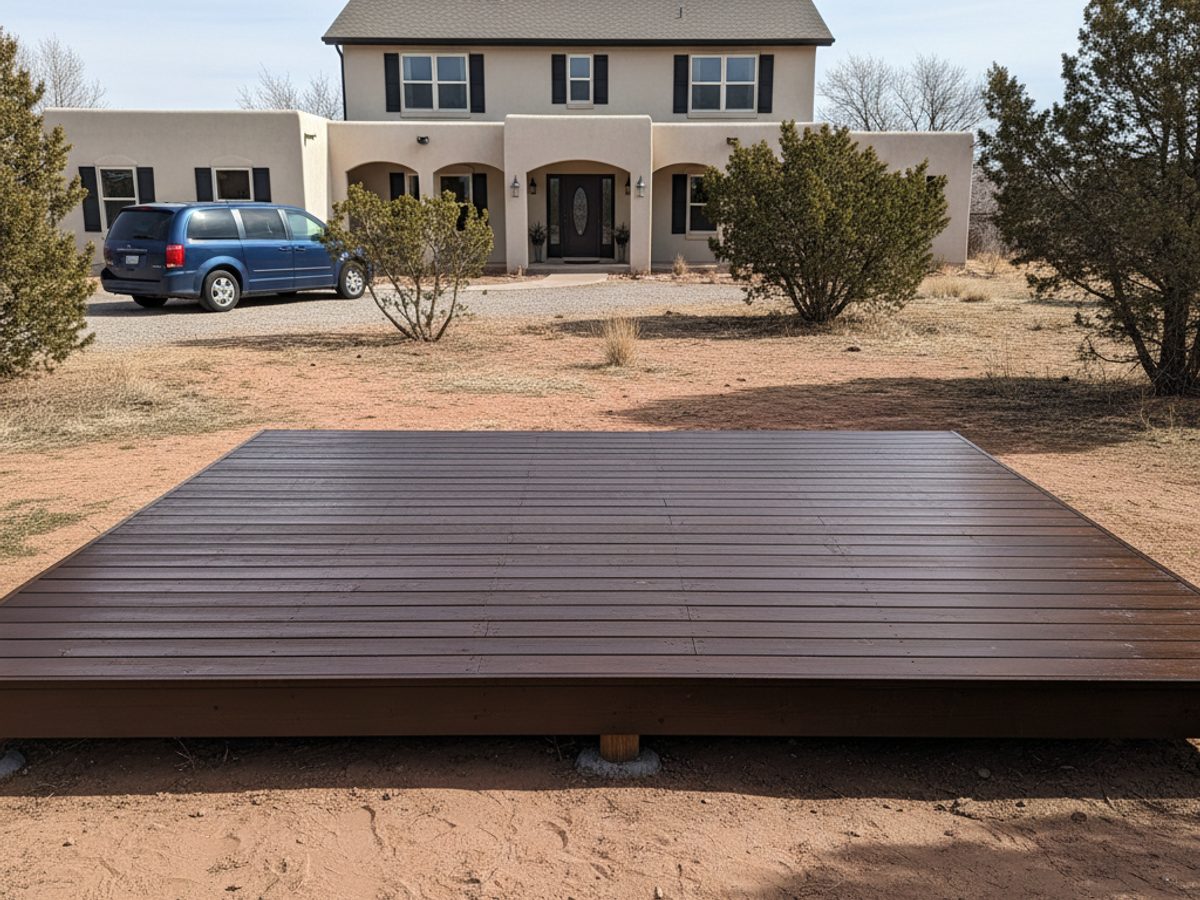
A bad deck doesn't look bad. That's the problem. You can stand on a deck with undersized joists and it'll feel fine for years, right up until eight people are on it for a barbecue and something gives. Choosing a deck builder in Chaparral is really about figuring out who's going to get the parts you'll never see right, the footings, the ledger connection, the framing under the boards. Everything else is finish work.
Ask about footings before you ask about railing style
Most homeowners walk into this conversation wanting to talk about composite color and railing style, which is fair, that's the fun part. But the first question worth asking a builder is what they're doing for footings and how deep they're going. Out here the soil is sandy on top and then you hit caliche, that hard, cemented layer of calcium carbonate that can sit a foot or two down and stop a post hole auger cold. A builder who's worked in Chaparral and the rest of Doña Ana County knows this and comes with a bar, a breaker bit, or a plan for it. A builder who's only worked in softer ground somewhere else might quote a price assuming easy digging, then hit caliche and either walk off the job or cut corners to finish it. Footings around here typically need to sit at least 12 inches down, sometimes more depending on soil and what the county requires for your lot, and they need to bear on undisturbed soil, not on loose fill dumped back in the hole.
The ledger board is where decks actually fail
Look up any deck collapse story and you'll find the same weak point over and over: the ledger board, the piece that bolts the deck to the house, pulls away because it was nailed instead of bolted, or bolted into rim joist that had already started rotting from water sitting behind it. A ledger needs through-bolts or heavy lag screws, not nails, spaced roughly every 16 inches, and it needs flashing behind it so water coming off the siding or stucco doesn't sit against the wood. Ask a builder how they attach the ledger and what flashing they use. If they shrug or say they just screw it to the house, that's a walk-away answer. This one connection point holds up the whole structure on that side, and it's also the one part almost no homeowner ever looks at again once the boards are down.
Railing height and baluster spacing aren't just style choices
Any deck more than 30 inches off the ground needs a guardrail, and code calls for it to be 36 inches high, measured from the deck surface to the top of the rail. The gaps between balusters can't let a 4-inch sphere pass through, a standard meant to keep a small kid from squeezing through or getting a head stuck. Stair rails need to run the full length of the stairs, and the rise on every step needs to match within about 3/8 inch, because that kind of inconsistency is exactly what trips people even when they're being careful. A builder who treats railing as a purely visual choice, picking cable versus wood versus metal without mentioning any of this, hasn't necessarily done anything wrong yet, but it tells you where their attention is going.
Permits and inspections in unincorporated Doña Ana County
Chaparral isn't an incorporated city, so building permits and inspections here run through Doña Ana County rather than a city building department. That matters because the process follows county setback rules and lot requirements instead of a municipal code, and it's worth checking your own property line and any easements before a design gets finalized. HOAs are uncommon in most of Chaparral, unlike some of the newer developments closer to Las Cruces, so you're less likely to need architectural approval, but you still need the permit itself for anything structural, and a deck of any real size almost always counts. A builder who tells you nobody bothers with permits out here is telling you either they don't know the rules or they don't want an inspector looking at their framing. Neither is a good sign.
What the climate does to the deck after it's built
This is high desert. Summers run past 95 for weeks at a time, humidity is low most of the year, and then July through September brings the monsoon, short, intense downpours that can dump more rain in twenty minutes than the ground sees the rest of the month. That combination pulls a deck in two directions. The heat and UV dry out wood fast, which is why pressure-treated lumber here often only needs six to ten weeks to dry before it's ready for stain, compared to the six months you'd wait in a wetter climate. But the monsoon means whatever grading and drainage is under the deck actually matters, because water that used to sheet off open ground now hits hard-packed dirt and framing instead, and it needs somewhere to go besides pooling under your new joists. A builder who thinks about where that water goes before pouring footings is worth more than one who's only thinking about how the top deck looks in the listing photo.
Wood versus composite, and what actually changes underneath
Pressure-treated pine is cheaper up front and it's what most of the older decks around here are built from, but it wants staining or sealing every two to three years in this sun, because UV breaks down wood fiber faster than it would somewhere with more cloud cover. Composite costs more, doesn't need staining, and won't splinter or rot, but the framing underneath still has to be built to spec, usually joists spaced 12 inches on center instead of the 16 inches used for wood, because composite boards flex more between supports. A builder who tells you composite can go over the same framing spacing as wood either doesn't know the manufacturer specs or isn't planning to follow them.
Red flags worth walking away from
- No written contract, or a contract that doesn't list lumber grade, footing depth, or fastener type.
- Wants full payment up front before any material is delivered.
- Can't tell you whether they're pulling a permit for your job.
- Quotes a price without ever asking about your soil or seeing the site.
- No insurance, or won't hand you a certificate showing it.
None of these mean the person can't swing a hammer. Plenty of guys who skip permits build a deck that holds up fine for a decade. But you're not just buying a deck, you're buying somebody's judgment on things you can't check yourself once the boards are down, and a builder who cuts corners on paperwork usually cuts them somewhere in the framing too.
Ask to see a finished deck they built at least a year or two ago, not the one from last month. A year of Chaparral sun and one monsoon season will tell you more about a builder's work than the day it was finished. That's the standard we build to at Champion Deck Company, and it's what we'd tell you to look for even if you ended up calling someone else.